Science should be ahead of the claims made in its name, not the other way around.
H[1] is a research intelligence engine. As a user of H[1], simply enter your research question in plain English. Then, we provide the amount of confidence the published evidence supports, all of the judgments behind that rating, along with the excluded studies and reasons for their exclusion.
You may ask a question through our research portal (on the web) or through the H[1] iPhone app. All assessments are stored within your personal research library.
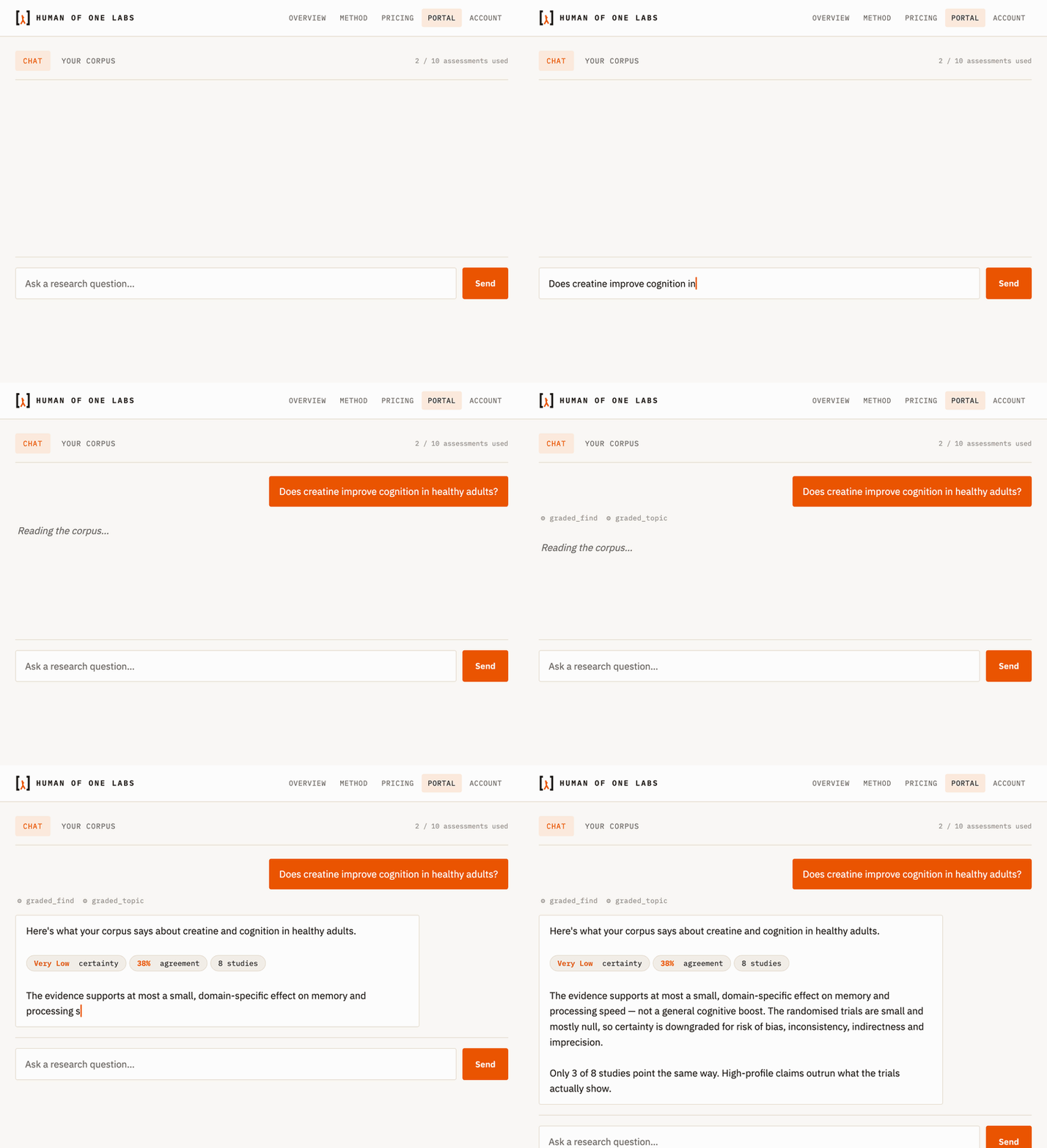
An LLM can explain science. H[1] lets it show its work.
Research intelligence you can check.
While general-purpose AI models have demonstrated impressive ability to identify trends, summarize large amounts of data and communicate complex ideas using simple terms, these models do not function independently as scientific evidence evaluation and recommendation platforms. These models can compile studies addressing different questions, ignore critical limitations and provide a confident response without a clear path back to the evidence.
H[1] gives an AI model a dedicated evidence and intervention layer. This layer structures research as a graph where each question is connected to its respective outcomes, population(s), studies, risk of bias judgments, exclusions and level of certainty.
The research portal brings the two components together. Claude handles conversations with users and answers questions from research that H[1] has evaluated. Each answer includes a link directly to the full assessment. No software needs to be installed and there is no key needed to use H[1].
LLM: the conversation. H[1]: the scientific structure, methods and interventions.
Three layers. One trustworthy answer.
You ask
Users may formulate their questions in plain English in either the research portal or the H[1] app. Users do not require knowledge of search syntax or of which studies exist.
Claude: the conversation
Upon receiving a user's query, Claude understands what was asked, identifies the assessed research that addresses that query and responds to that query in plain language. In cases when there is no research yet that covers the question, Claude offers to research it.
H[1]: the evidence system
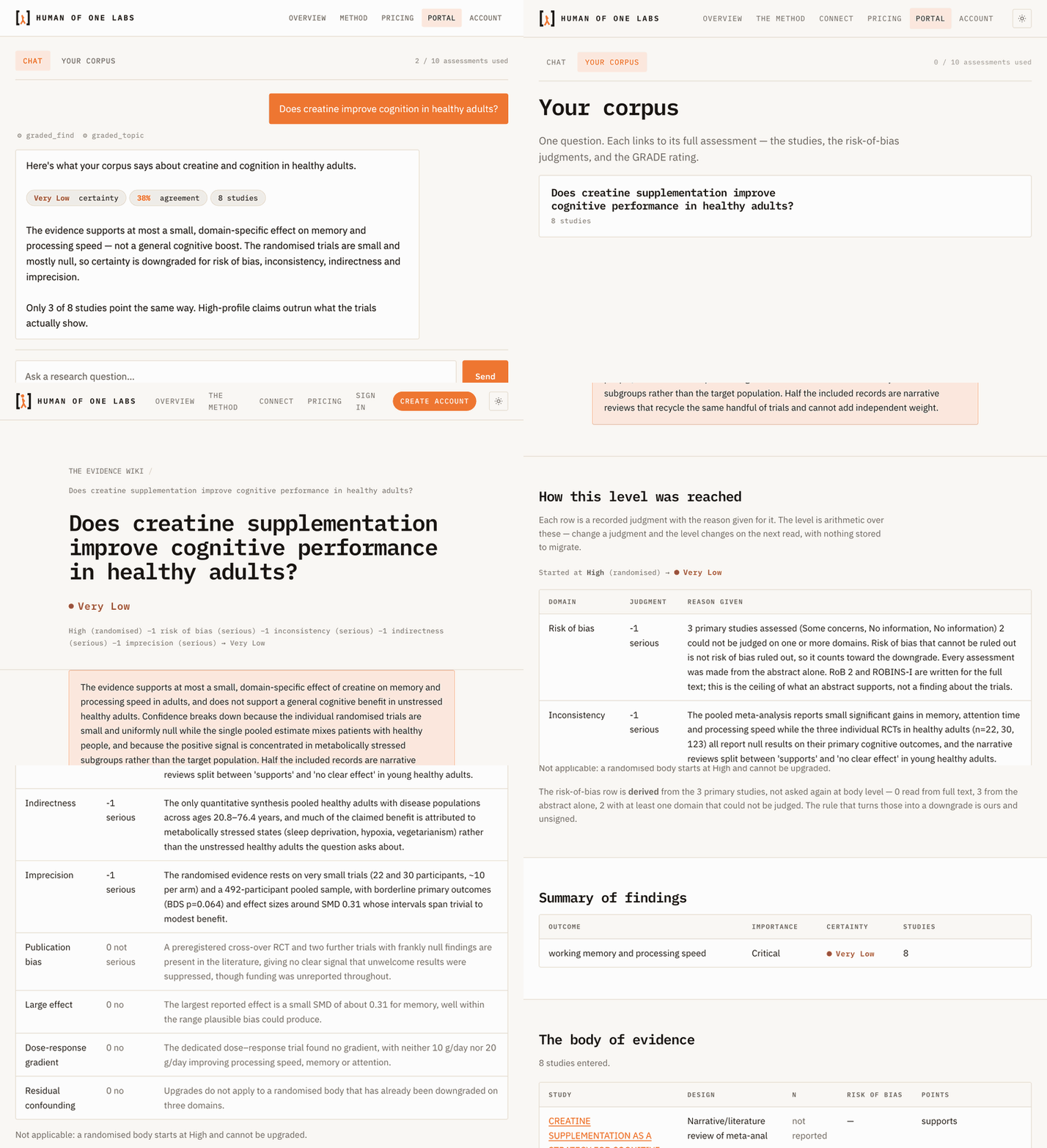
Using a structured evidence graph, H[1] searches the relevant body of research, evaluates it and provides the certainty level, supporting studies, limitations, studies excluded, and the reasoning behind the result.
Every person is an N of one.
Science studies populations. Life happens one person at a time.
Research indicates what generally happens within a specific group, under a specific set of circumstances. The conclusions drawn from the evidence are based upon who was included in the research (the participants), what was being evaluated (the measurements taken), the way the research was designed, the sample size, the statistical assumptions made during the analysis, as well as the degree of uncertainty associated with the results.
While this evidence is crucial to consider, it does not directly inform us regarding what will work for a given individual - a unique combination of biology, history, environment, goals, etc., as well as their present moment.
The average is useful. It is not an individual.
H[1] provides clear, reliable population evidence to build on: what the existing research supports, the degree of confidence associated with each finding, and the limitations of the findings. That is the evidence layer any truly personalized system must be built on.
A research intelligence engine using its own method, H[1] Engine, to evaluate published studies and report the certainty of the evidence for each outcome individually.
The engine's certainty evaluation follows GRADE. Certainty is not a numerical value out of something. Rather it is categorized using levels (High, Moderate, Low or Very Low) reached through reasoning that starts with study design and moves only for stated reasons. Each move made is documented with the feature of the evidence responsible for that decision.
Where to use it
The research portal
Sign in and ask. Every response includes how much the evidence supports and allows you to view the entire assessment including derivation, all judgments along with the reason for each, and all excluded studies. Research you commission also gets added to your own research library.
H[1] for iPhone
Your portable research portal + one thing to try from your wearable data or an honest no.
For developers
You can call the same engine from Claude, ChatGPT or your own application via MCP or embed it using the SDK.
The kind of question it answers
Ask in the portal, then open Your corpus to view the entire assessment – full derivation of certainty, every domain judgment with its reasoning, and the studies behind it.
Cold plunges and recovery
Does cold water immersion after training improve recovery?
Creatine and cognition
Does creatine supplementation improve cognitive performance?
Interval training and VO₂max
Does interval training improve VO₂max in healthy adults?
Passive body heating and sleep
Does hot-water bathing before bed improve sleep?
Small, and honest about it.
Each number here was read from the current corpus rather than transcribed. The method is completed and has been tested; however, the body of assessed research is early and grows one question at a time.
1
question rated end to end, shown in full
10
assessed for risk of bias · 10 admitted to a body of evidence
No study has been excluded from a body yet; however, if one is excluded because of High or Critical risk of bias, it will be noted by name and domain as such. Additionally, No information is deliberately not an exclusion – a potential source of bias that cannot be ruled out is still a source of bias and therefore the study will remain in the body while the body as a whole is downgraded for it.
Meet the Team
Giselle Requejo
Founder · research systems & product
Published neuroscience researcher & software engineer. Responsible for the assessment pipeline, the research portal, and the standard's machinery.
Michael Mannino, PhD
Chief Science Officer
Neuroscientist and editor of the Springer textbook Performance Neuroscience; published researcher on topics ranging from complex systems, human performance, cognition, and artificial intelligence. Leads the scientific architecture at H[1], translating rigorous evidence standards into transparent, auditable systems which both humans and artificial intelligence can use.
See what H[1] evaluates next.
When we evaluate a new research question we send an update. We also send updates when we expand our evidence corpus, or when there are meaningful changes made to our methodology. If you asked about a specific topic we will notify you as soon as its assessment is available.