Your wearable asks the research. You get one thing to try, or an honest no.
The H[1] app compares your nights to your own baseline, turning any changes into research questions that the app then answers with H[1] Engine, the same method behind everything else on this website.
That goes along with the H[1] research portal – ask anything you want to know about sleep, recovery, exercise and healthspan, and find out how certain the evidence is.
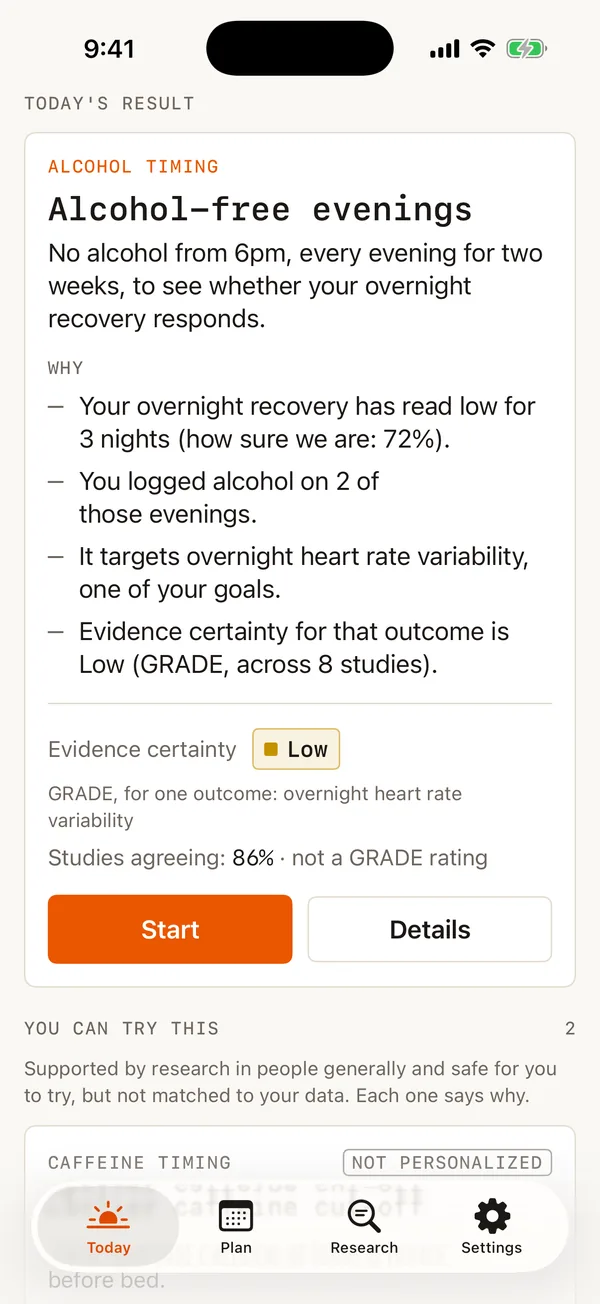
From last night to one thing to try.
Six steps, and every one of them shows its work.
-
01
Wear what you already wear.
Your Apple Health app brings in your watch, and the sleep and heart data that apps such as WHOOP, Oura and Garmin write to it. WHOOP and Google Health (Fitbit and Pixel Watch) also connect directly, for the heart rate variability they keep to themselves. We plan direct connections to Oura and Garmin soon.
-
02
Read against you, not the average.
Each night will be compared to your own baseline history — not a chart showing the average person — and report back on how confident the reading is. If there isn’t enough history yet to make a comparison, the app will tell you instead of guessing.
-
03
Your readings become a research question.
Low overnight HRV after evening drinks becomes “alcohol”, “heart rate variability”, “vagal tone” in terms of the literature. No number of yours will appear in the search; at most it names a range your data puts you in, such as adults sleeping under 6 hours.
-
04
If nobody has asked yet, it asks.
If there is something in the library that H[1] Engine cannot answer yet, it will research it, once, for everyone using the tool. The response includes a certainty level following GRADE: High to Very Low — in addition to the stated reasons why it earned that rating — per individual outcome.
-
05
One thing to try, or an honest no.
First, safety checks occur. Next, the ontology ranks what fits your state, your goals and the existing evidence — before suggesting one single intervention and reporting its certainty. All interventions are designed by humans; however, no one hand-picks which one you receive.
-
06
Try it, and see how you respond.
Use it for two weeks, log how it goes, and observe what happened to your readings. A run is a reading — not proof. Your record grows.
The research portal, in your pocket.
Ask about sleep, recovery, exercise, supplements and healthspan in plain words — you don't even need to refer to your data.
The Research tab within the app is the H[1] research portal. Responses are derived from research assessed by H[1] Engine and express the degree of confidence in those findings: their certainty, following GRADE. Opening any of these responses reveals the complete assessment including derivation, reasoning for every judgment, and which studies were excluded plus the reasons for exclusion.
When no one has previously asked your question, it offers to research it — you simply tap a button to start a new assessment. Each month comes with an allowance of new questions, however reading the library is always free.
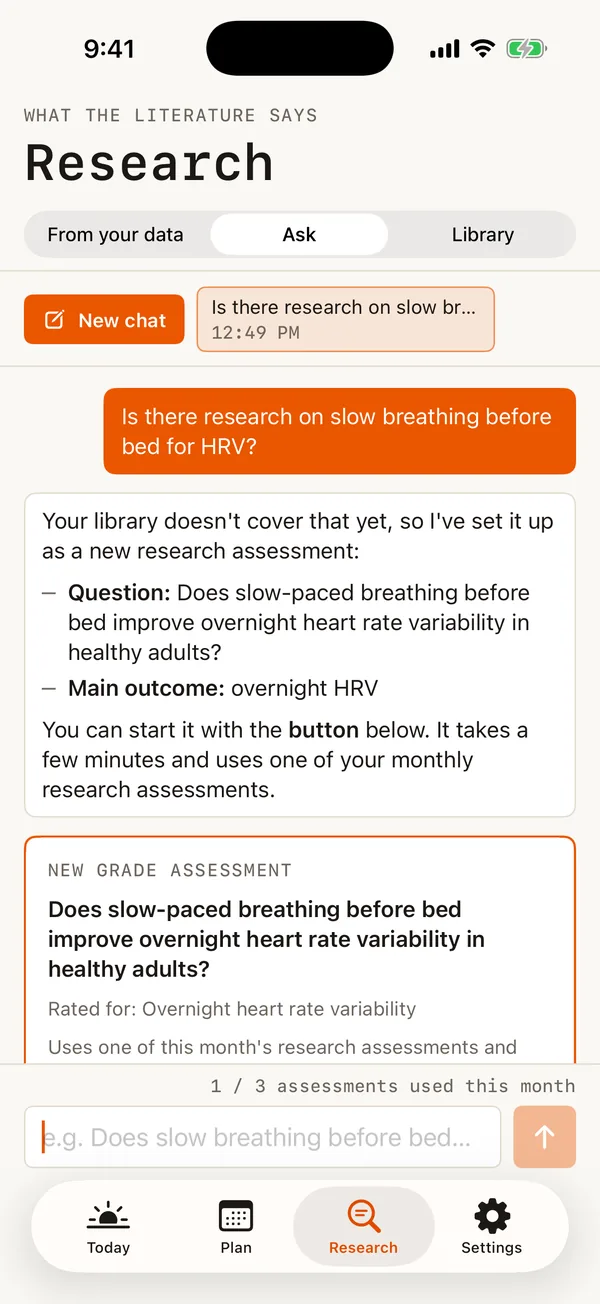
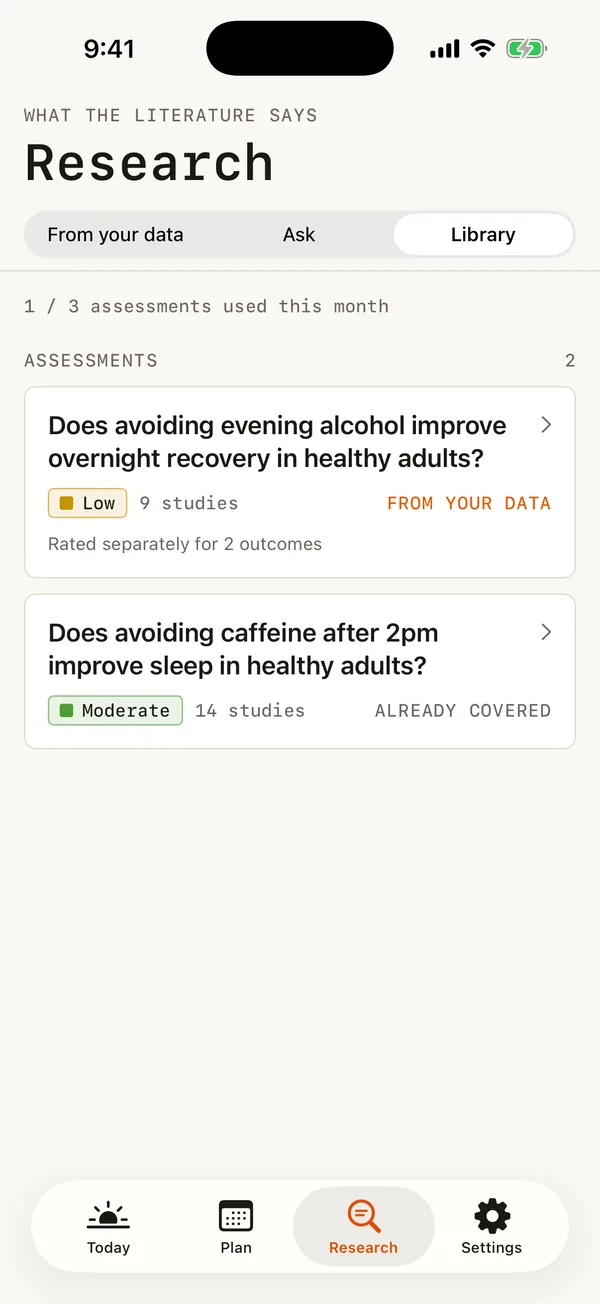
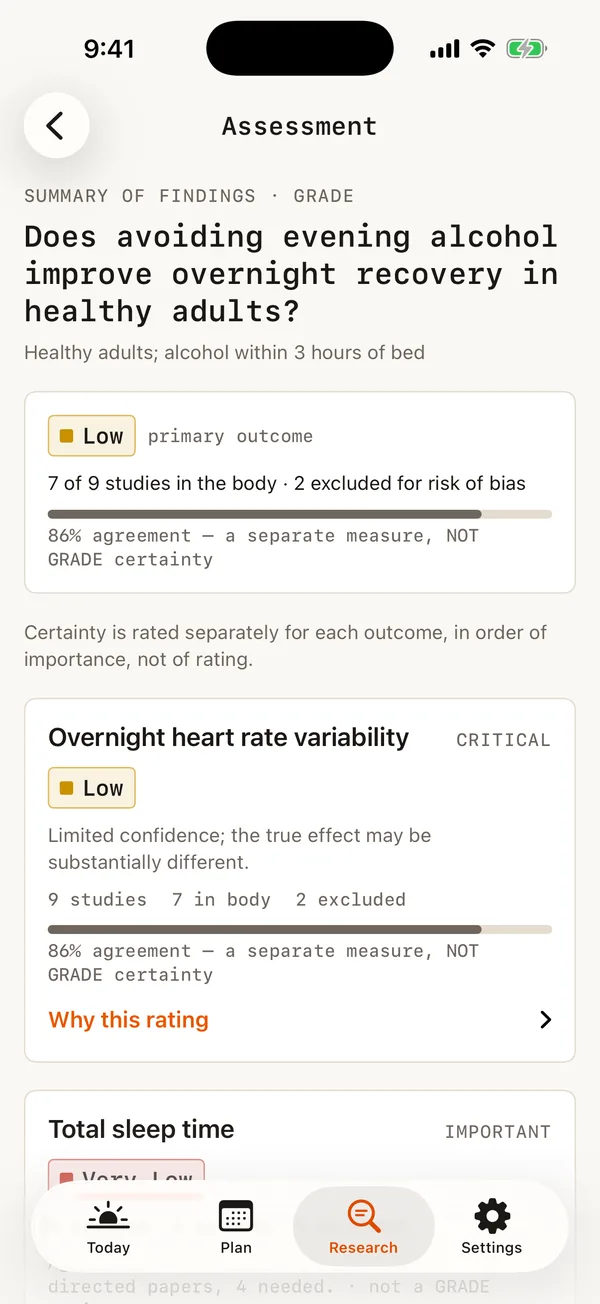
Inside the app.
Real screens, showing sample data.
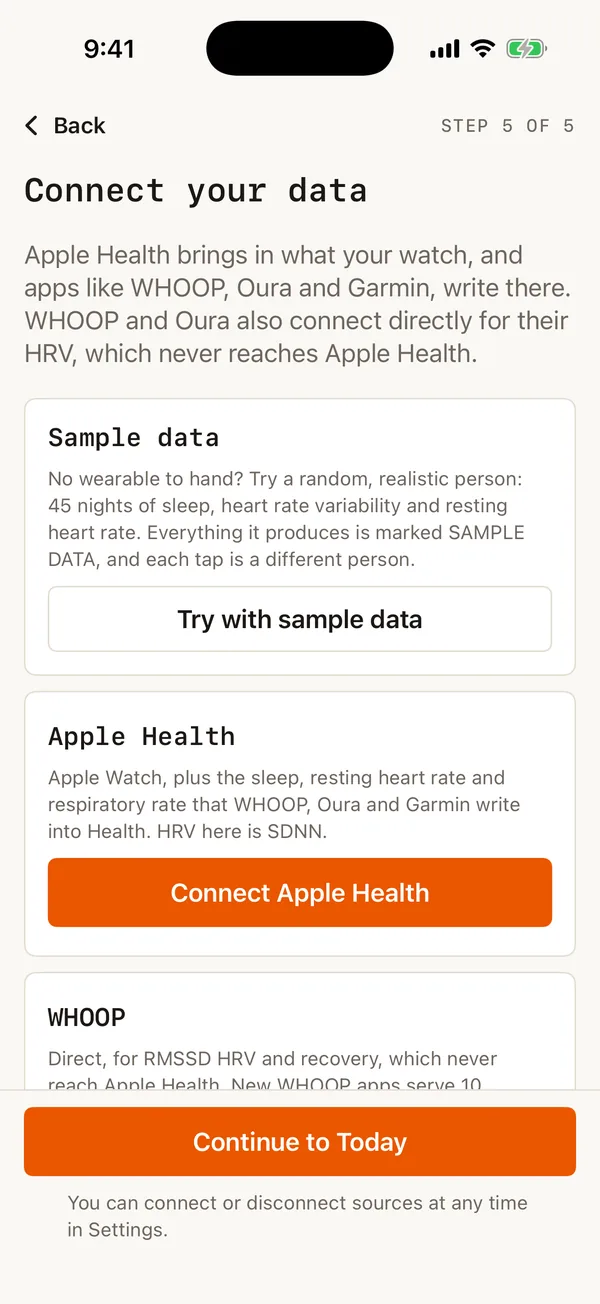
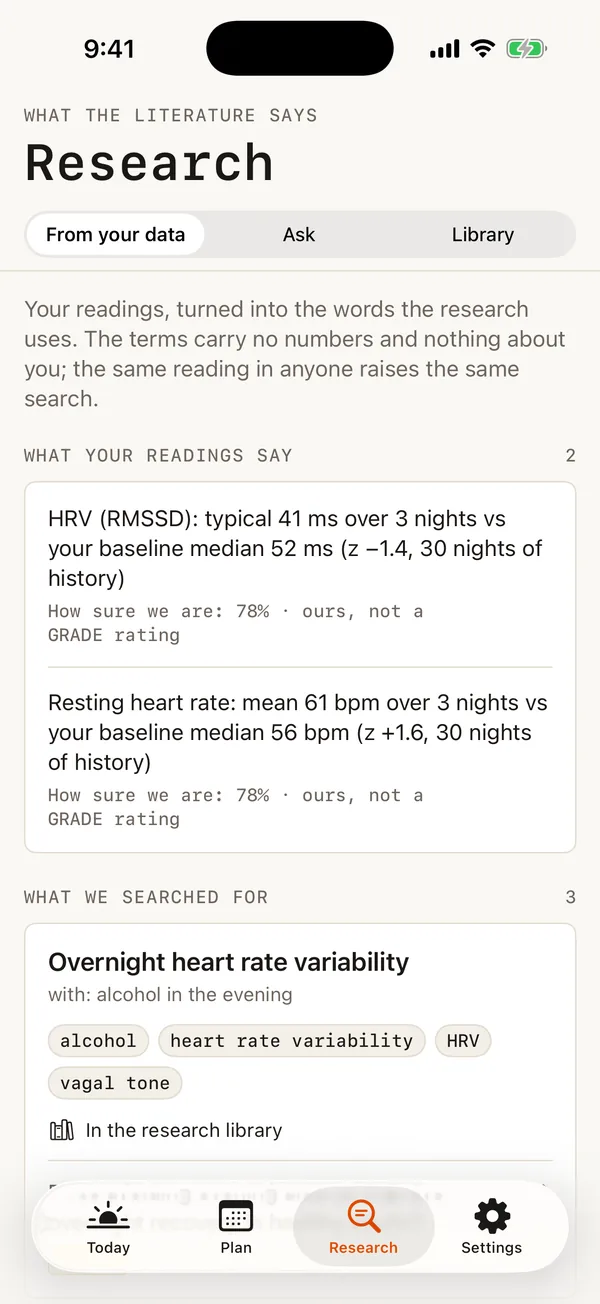
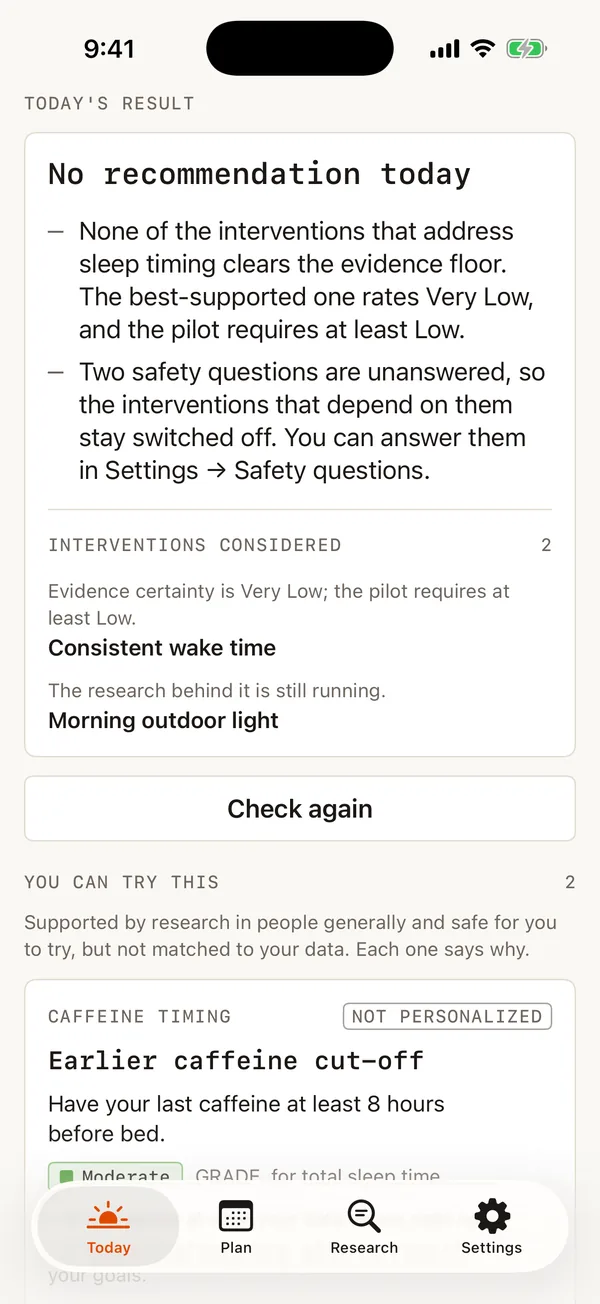
“No recommendation” is an answer.
Most published research on everyday habits is thin, and the app says so.
You will only receive an intervention if the evidence supporting it rates Low or better. Most of what has been evaluated thus far receives Very Low ratings. As a result, on many days the app will recommend nothing. However, it will provide information regarding what the available body of research indicates and will identify which interventions were considered and why each was set aside.
There's no way around it — an app that always has an answer is going to be guessing some of the time. That is why our app tells you when it would be.
Four numbers, never merged.
Each answers a different question, and each is labelled for what it is.
Evidence certainty
Following GRADE: how much confidence the research supports, for one outcome.
Studies agreeing
How much of the literature points the same way. Ours, and not a GRADE rating.
How sure we are
How confident the app is about your state, from your own nights.
How this ranked
Orders the options for you today. It doesn’t predict the size of your response.
Get the beta.
The H[1] app is currently in private beta testing on TestFlight for iPhone. Send us your email address and we'll notify you when we open up access for public beta testing.
The app has its own privacy policy, terms of use and consumer health data policy, covering Apple Health and the wearables you connect. They are separate from this site’s.